VOLTIXC / ENQUIRY
Request a Quote
Tell us what you need and we will review your enquiry.

Fast answer: VoltixC is a cable lug manufacturer in Guangzhou, China, that also makes wire terminals, serving North American and European buyers from a 1,200 m² factory with 25 staff and 135 production machines. Choose copper tube lugs, mechanical screw lugs or insulated terminals, then send conductor size, stud hole and drawings through the enquiry form for a tailored quote.
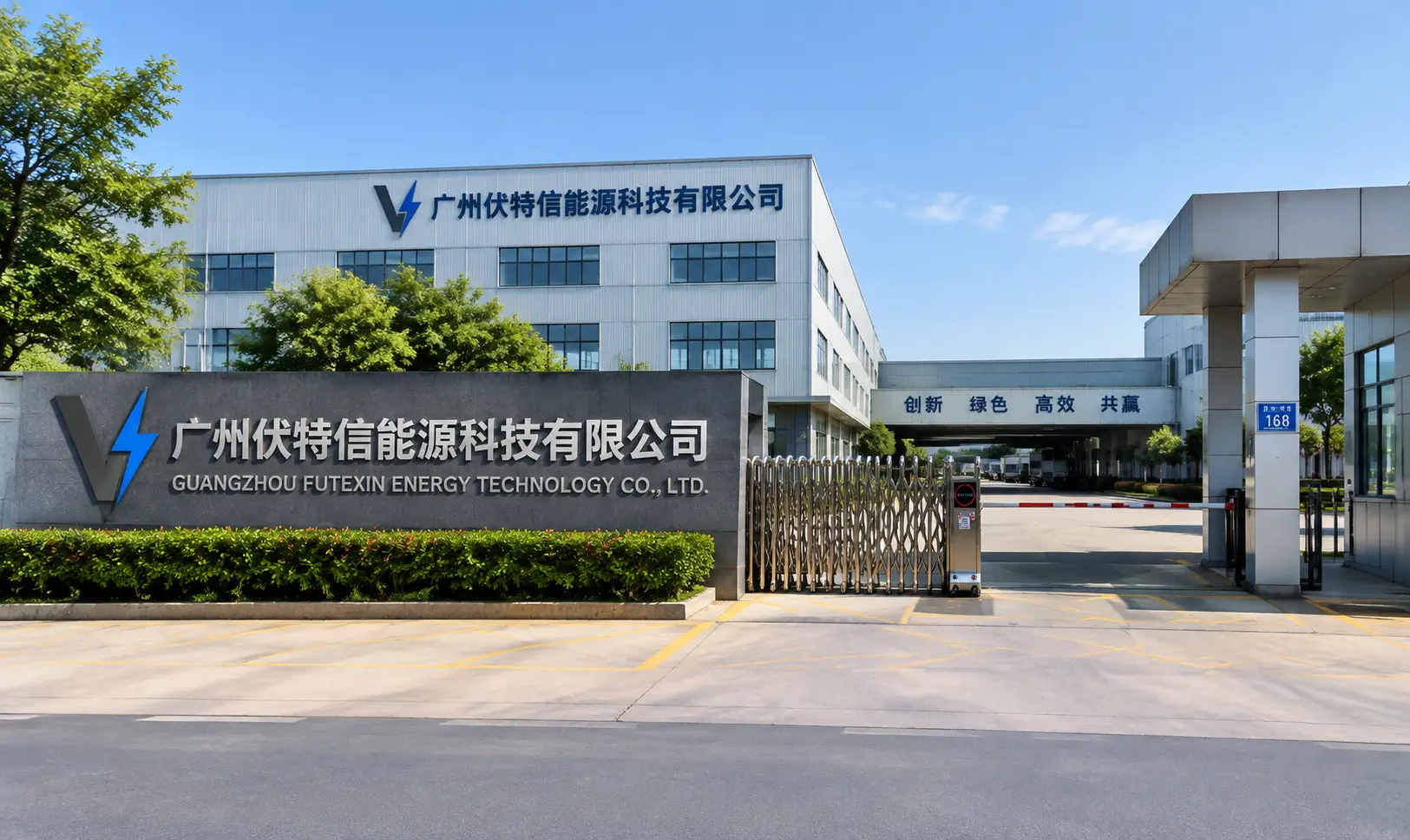
Copper lugs, mechanical lugs and insulated terminals, built to your drawing in Guangzhou. VoltixC was founded in 2021 and makes cable lugs and wire terminals in its own workshop in Baiyun District, so the team that quotes your electrical lugs and terminals is the team that makes them.
| Founded | Factory | Staff | Production machines | Fastest sampling | Enquiry response |
|---|---|---|---|---|---|
| 2021 | 1,200 m² | 25 (17 in production) | 135 | 7 days | 24/7 |
Source: VoltixC company facts sheet, 2026.
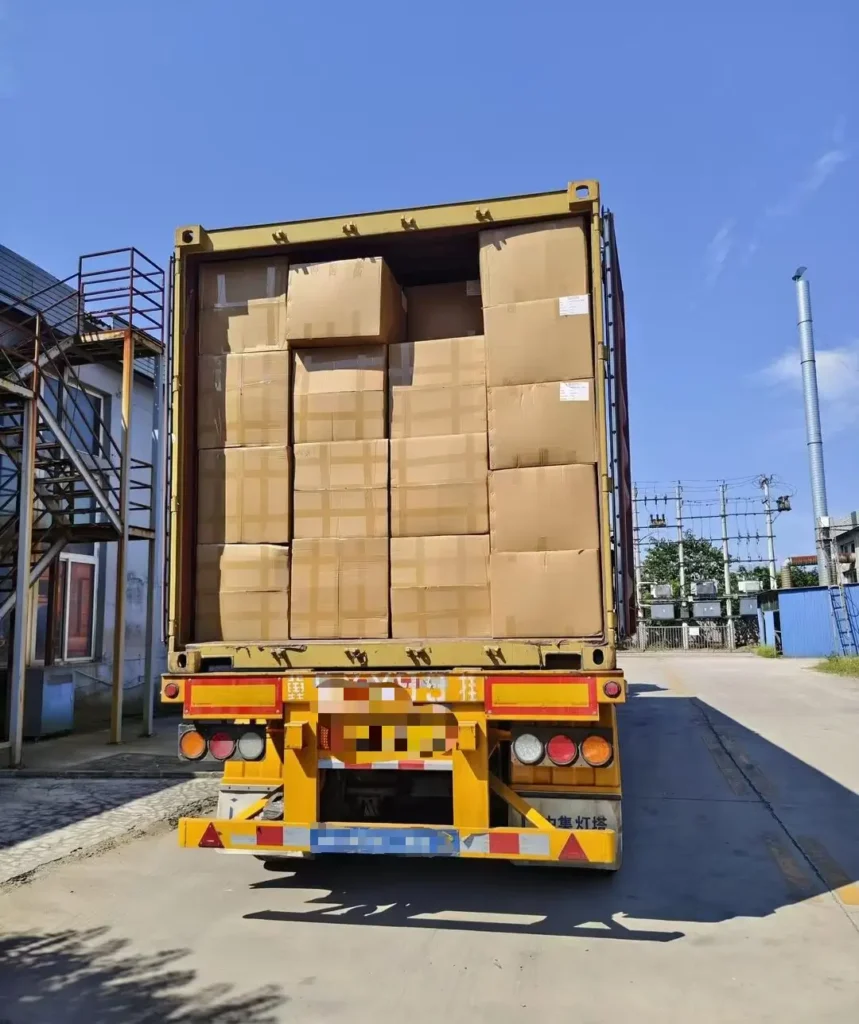
A VoltixC order moves through five steps: specification, part match, order terms, production, then packing and shipment. Each step needs one input from the buyer, and the list below names it, so nothing waits on a missing detail.
A size written without its unit holds up step 1: “50” can be a cross-section in mm², a stud size or a quantity, and “1/0” and “50 mm²” are different sizing systems. Writing the unit next to every size lets the enquiry go straight to step 2.
VoltixC offers three terminal families, all made in one factory: copper cable lugs, mechanical lugs and insulated wire terminals, spread over 21 product pages built from 43 supplier series. Each family holds the conductor in a different way, so choose the family first and the size second.
A copper cable lug is crimped or compressed onto the cable through a tube barrel. A mechanical lug clamps the conductor under a set screw. An insulated terminal is crimped through a nylon or vinyl cover that helps insulate the barrel. Copper is the default lug metal because of its conductivity, and according to the U.S. Geological Survey, electrical uses of copper account for about three quarters of total copper use.
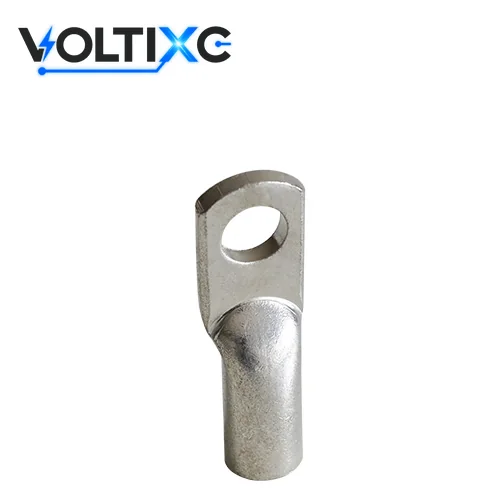
Copper tube and compression terminal lugs, plus splice connectors, for stranded copper cable in high current battery, power distribution, switchgear and transformer connections, with supplier-listed sizes reaching 2,000 kcmil in the DIN 46235 series; the smallest size differs by series and is listed on each product page.
See cable lugs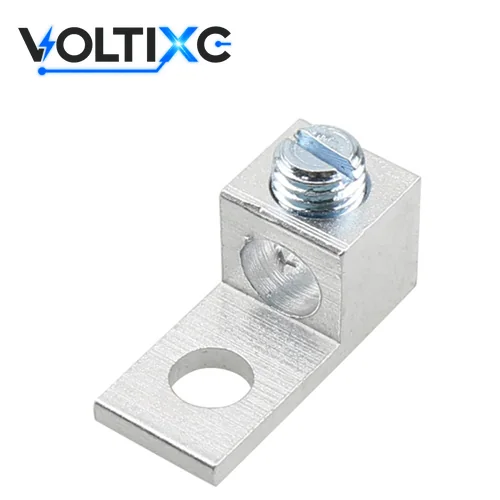
Set screw lugs with aluminum bodies (AM and CM series) and an aluminum-alloy lay-in lug, taking copper or aluminum conductors; an electrician fits and re-tightens them on site with a hex key, with no crimping die needed. Conductor ranges and conductor marking are confirmed per order.
See mechanical lugs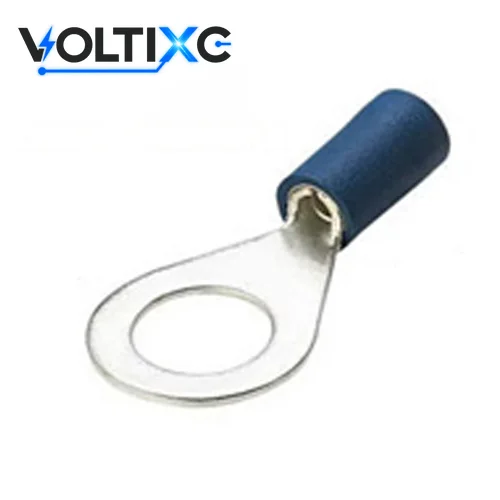
Ring, spade, quick disconnect, bullet, butt splice, closed-end, ferrule and solder-seal terminals, mostly listed in the 22–16, 16–14 and 12–10 AWG bands.
See crimp connectorsStraight copper tube lugs from the T, TL, TLK, LYF and CL-H series, supplier-listed from 16 AWG to 1000/1250 kcmil, bare or tin plated to order.
View tinned copper tube lugsCopper lugs sized in AWG for battery, inverter and panel cable, supplier-listed from 8 AWG to 4/0 AWG.
View AWG copper battery lugsCompression lugs for buyers who specify to the DIN 46235 system; the supplier data lists them from 12–10 AWG up to 2,000 kcmil.
View DIN 46235 cable lugsOne page for both metals: copper versions listed from 14–10 AWG to 1,000 kcmil and aluminum versions from 8 AWG to 700 kcmil.
View one-hole compression lugsAM and CM set screw lugs with aluminum bodies, listed from #14 AWG to 1000 kcmil (100 part numbers).
View aluminum and copper mechanical lugsGrounding lugs with an aluminum-alloy body and an open lay-in channel, so a continuous ground conductor can pass through without being cut; the conductor metal is confirmed per order.
View lay-in grounding lugsVinyl and nylon ring terminals listed from 16–14 AWG to 12–10 AWG, with nylon versions also listed at 8 and 6 AWG.
View insulated ring terminalsCord-end ferrules for fine-stranded wire in screw clamps, listed from 26 AWG upward in the insulated and non-insulated series.
View wire ferrulesChoose a lug by conductor size and stud hole, not by amperage alone. The first table routes each product line by conductor metal, attachment method and supplier-listed conductor range; the second narrows a known wire size to a starting page and a stud-hole check.
| Product line | Terminal material (supplier-listed) | Attachment method | Conductor range (supplier-listed) | Common use | Go to page |
|---|---|---|---|---|---|
| Tinned copper tube lugs | Copper | Crimp on a tube barrel | 16 AWG to 1000/1250 kcmil | Power distribution and battery cable | Tinned copper tube lugs |
| AWG copper battery lugs | Copper | Crimp on a heavy-wall barrel | 8 AWG to 4/0 AWG | Battery, inverter and DC cable | AWG copper battery lugs |
| DIN 46235 compression lugs | Copper | Compression | 12–10 AWG to 2,000 kcmil | Projects specified to DIN 46235 | DIN 46235 cable lugs |
| One-hole compression lugs | Copper; aluminum | Compression | Copper 14–10 AWG to 1,000 kcmil; aluminum 8 AWG to 700 kcmil | Feeder and panel terminations | One-hole compression lugs |
| Mechanical lugs | Aluminum | Set screw clamp | Confirmed per order | Field terminations that may be re-made | Aluminum and copper mechanical lugs |
| Lay-in grounding lugs | Aluminum alloy | Set screw over a lay-in channel | 14 AWG to 250 kcmil | Grounding and bonding runs, for buyers who need a grounding lug manufacturer | Lay-in grounding lugs |
| Insulated ring terminals | Confirmed per order | Insulated crimp, vinyl or nylon sleeve | 16–14 AWG to 12–10 AWG; nylon also 8 and 6 AWG | Control and panel wiring to a stud | Insulated ring terminals |
| Wire ferrules | Confirmed per order | Crimp sleeve, with or without insulation collar | 26 AWG upward, by series | Fine-stranded wire into screw clamps | Wire ferrules |
Source: supplier data per series in the VoltixC product knowledge base; ranges are supplier-listed, not retested item by item, and confirmed per order.
North American buyers give wire sizes in AWG or kcmil and European buyers use metric mm², so state the unit with every wire and cable size. Stud-hole options vary by series, so the matrix below sends you to a page or to the lug size chart rather than listing every hole.
| Conductor size band | Approx. mm² | Where to start | Stud hole |
|---|---|---|---|
| 26–10 AWG (small wire) | 0.13–5.3 mm² | Insulated crimp connectors | Ring or spade tongue by stud size, listed per series |
| 8 AWG–4/0 AWG (heavy duty battery and panel cable) | 8.4–107 mm² | Battery lugs | One-hole or two-hole lug, listed per series |
| 250–1,000 kcmil (feeder cable) | 127–507 mm² | Cable lug size chart | Stud size, or bolt holes and spacing for two-hole palms |
| Mixed or unknown | Any | Request a quote | Send a drawing or photo |
Source: AWG and kcmil to mm² values are standard conversions, rounded; stud holes are listed per series and confirmed per order.
Common battery cable sizes such as 8 AWG, 6 AWG, 4 AWG, 2 AWG and 1 AWG fall in the copper cable lug band, while 14 AWG and thinner electrical wire usually takes an insulated terminal. A flexible copper conductor and a standard stranded copper wire of the same size can need different barrels, so give the strand class. When you compare lugs, check the barrel length, the cable insertion depth and any entry flare as well as the stud hole and mounting bolt.
The UL wire connector standard shows how wide the conductor range of a connector can be. According to UL Standards & Engagement, UL 486A-486B applies to single-polarity connectors used with copper, aluminum, or copper-clad aluminum conductors in installations governed by the Canadian Electrical Code, NFPA 70, or NOM-001-SEDE. According to UL Standards & Engagement, the copper conductor ranges listed for UL 486A-486B are 30 AWG through 10 AWG solid and 30 AWG through 2,000 kcmil stranded. VoltixC cites UL 486A-486B here only for its conductor ranges; naming the standard is not a claim of listing under it.
Match the application to a family first: battery and DC cabling points to copper battery lugs, switchgear and feeders to tube, compression or mechanical lugs, and control panels to insulated terminals and ferrules. The cards below show which family is suitable for each condition, with one selection point and the standard context. They describe typical installations, not VoltixC customer projects.
Recommended: AWG copper battery lugs and tinned copper tube lugs. Selection point: battery cable is often finer-stranded than building wire of the same gauge, so give the strand class and match the palm hole to the battery post or busbar stud. Standard context: under the RoHS definition, EEE is dependent on electric currents or electromagnetic fields and is designed for no more than 1,000 V AC or 1,500 V DC. Check the finished equipment against that definition before asking for RoHS documents on its lugs. How to choose: send the post or stud size together with the cable’s strand class, because a lug that fits the post but not the strands will not crimp tightly.
Recommended: tinned copper tube lugs, one-hole and two-hole compression lugs, and mechanical lugs where terminations may be re-made. Selection point: a two-hole palm stops the lug from turning on the bus, and compact-stranded cable has a smaller diameter than standard stranding of the same size, so say which one you use. Standard context: according to UL Standards & Engagement, compact-stranded copper conductors are covered from 8 AWG and larger in Canada and Mexico, and from 2 AWG and larger in the United States.
Recommended: aluminum one-hole and two-hole compression lugs, and aluminum dual-rated mechanical lugs. Selection point: an aluminum conductor needs a lug made for aluminum, so write the conductor metal on every line of the enquiry. Standard context: according to UL Standards & Engagement, the aluminum conductor ranges listed for UL 486A-486B are 12 and 10 AWG solid, 12 AWG through 2,000 kcmil stranded, and 12 AWG through 1,000 kcmil stranded single-input wire.
Recommended: insulated ring and spade terminals, quick disconnects and wire ferrules. Selection point: the sleeve size band, such as 22–16, 16–14 or 12–10 AWG, must match the wire, and fine-stranded wire going into a screw clamp takes a ferrule. Standard context: according to Commission Delegated Directive (EU) 2015/863, DEHP, BBP, DBP and DIBP are substances of very high concern whose use in EEE can harm recycling, human health and the environment during waste management. These four are plasticisers, so for a vinyl-insulated terminal the RoHS question covers the sleeve as well as the metal.
Recommended: tin plated copper tube lugs, and solder-seal connectors where a splice must be sealed. Selection point: a tin layer slows surface corrosion on copper, and the cable entry should be sealed, so state the environment and any sealing requirement in the enquiry. How to choose: write tin plating on the enquiry for any lug that will sit in moisture or salt air, because a bare and a tinned lug of the same size are different parts; plating type and thickness are confirmed per order against your specification.
Two size-finder tools and two size guides let you narrow a part before you write to VoltixC; paste the result into the enquiry form as your size list. The site has two tool pages, so the other two cards are reading guides.
Look up cable lug sizes by conductor size and stud, then note the candidate lug for your enquiry. The same page explains what each column in a lug size table means, from barrel size to hole diameter, so you can read a supplier’s chart the same way.
Open the cable lug size chartLook up insulated ring terminal sizes by wire gauge band and stud.
Open the ring terminal size chartWhich dimensions of a lug to measure or specify on a drawing.
Read the dimensions guideHow battery cable gauges map to lug barrels and stud holes.
Read the battery lug size guideVoltixC is UL certified, its CE attestation covers all VoltixC products, and a RoHS test report is available from SGS; the three documents are shown below as images. Certificate numbers and dates are not listed on this page, and naming any other standard or directive here is not a claim of certification to it.
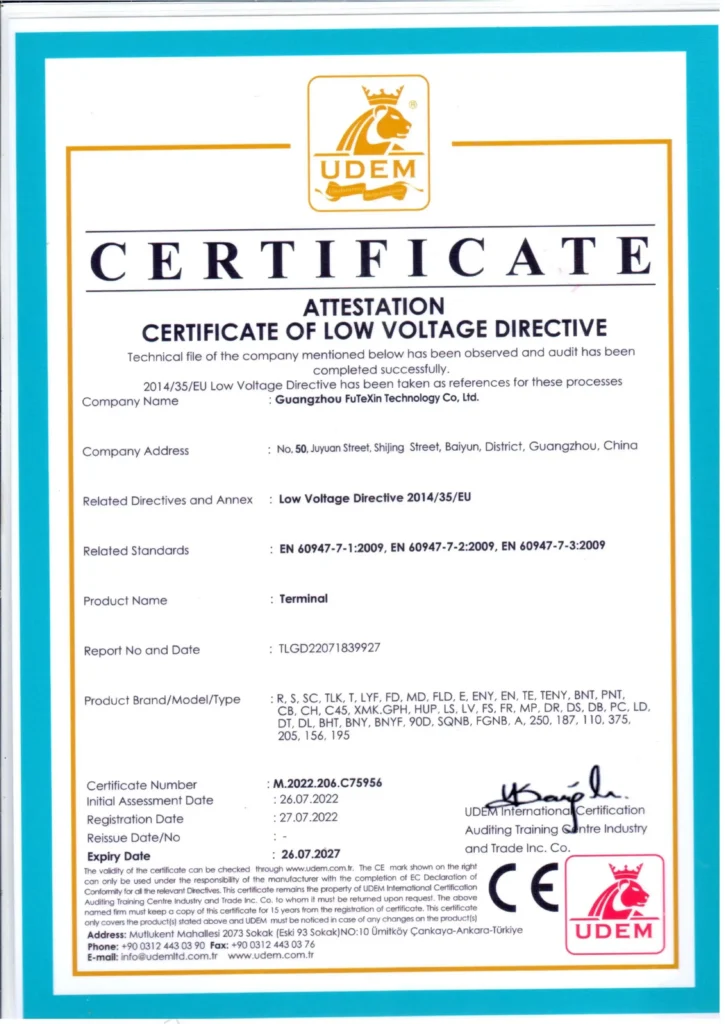
CE: covers all VoltixC products under the Low Voltage Directive 2014/35/EU, with EN 60947-7-1, EN 60947-7-2 and EN 60947-7-3 named as the standards. According to the European Commission’s Low Voltage Directive guidance, for products that need it, CE marking can only be affixed after testing the product and performing the conformity assessment procedure prescribed by applicable EU harmonisation legislation.
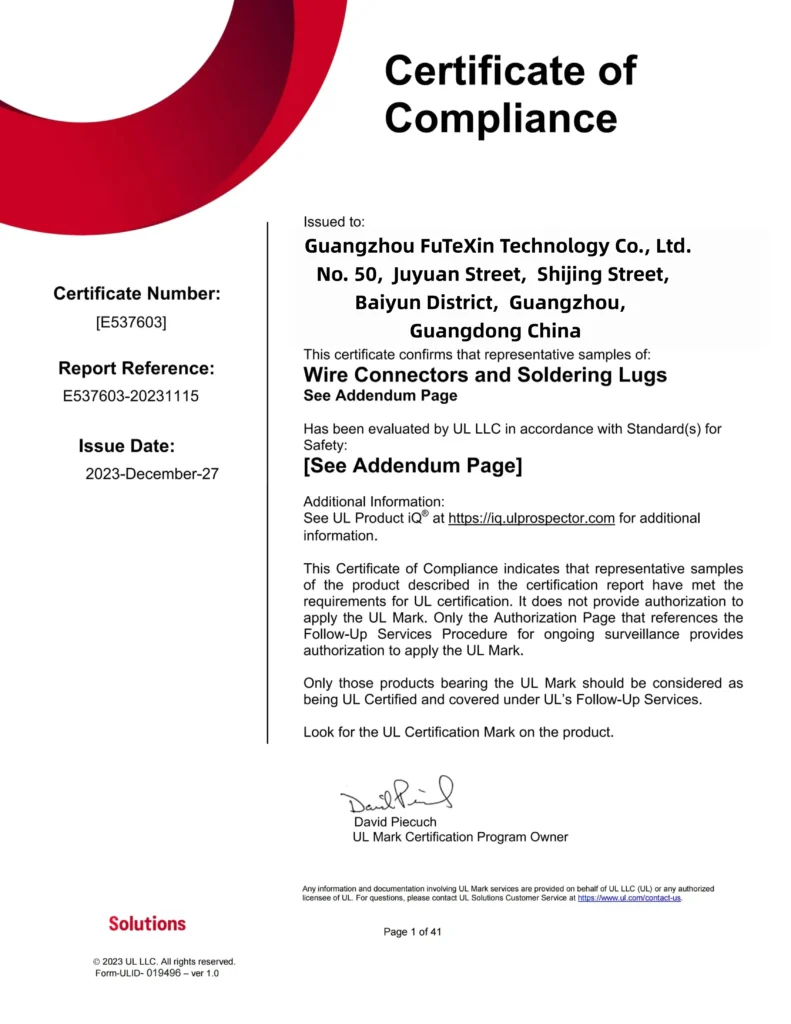
UL: VoltixC is UL certified; the certificate image is on file for North American buyers. The UL wire connector standard quoted in the size section above is cited only for conductor ranges, not as the scope of this certificate. If your project requires a specific listing, name it in your enquiry.
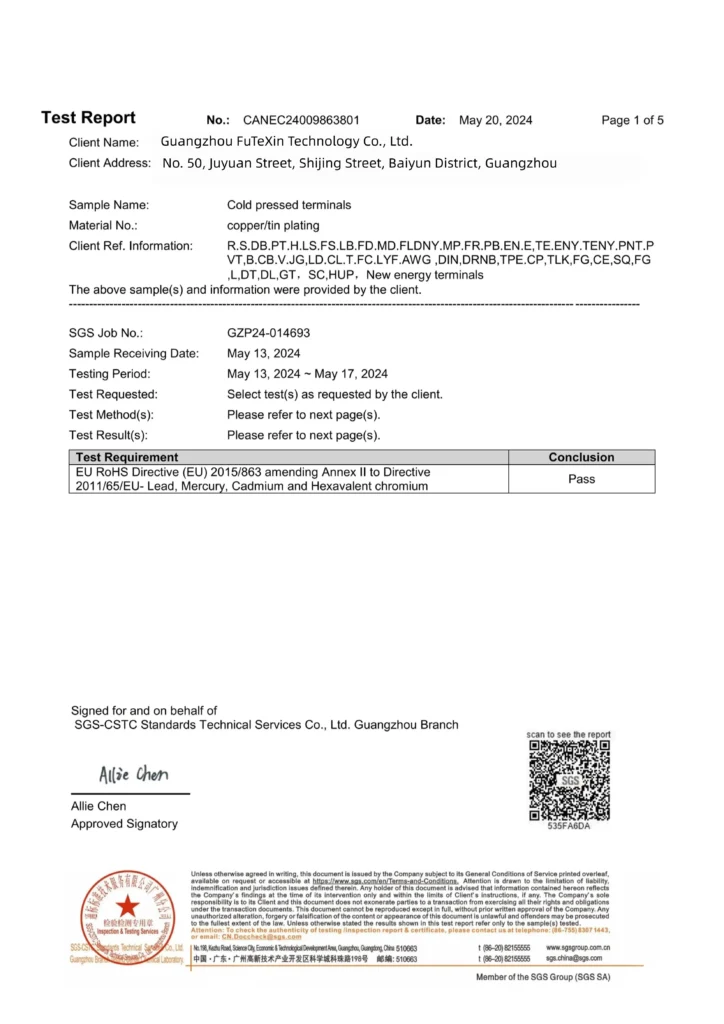
RoHS: RoHS test report available (SGS), testing lead, mercury, cadmium and hexavalent chromium on tin-plated copper terminal samples. Directive 2011/65/EU lays down rules restricting hazardous substances in electrical and electronic equipment (EEE) to protect human health and the environment.
For a buyer, RoHS answers one question: which substances may be present in the metal, plating and sleeve of a part, and at what level. The European Commission overview states that RoHS currently restricts ten substances: lead, cadmium, mercury, hexavalent chromium, PBB, PBDE, DEHP, BBP, DBP and DIBP.
| Substance group | Maximum concentration by weight in homogeneous materials |
|---|---|
| Lead, mercury, hexavalent chromium, PBB, PBDE | 0.1% each |
| Cadmium | 0.01% |
| DEHP, BBP, DBP, DIBP | 0.1% each |
Source: Commission Delegated Directive (EU) 2015/863 amending Annex II to Directive 2011/65/EU.
The amended Annex II sets lead, mercury, hexavalent chromium, PBB and PBDE at 0.1% and cadmium at 0.01% by weight in homogeneous materials. The amended Annex II sets DEHP, BBP, DBP and DIBP each at 0.1% by weight in homogeneous materials. Because the limits apply to each homogeneous material rather than to the finished lug, check that any RoHS document you receive names the part family you are buying.
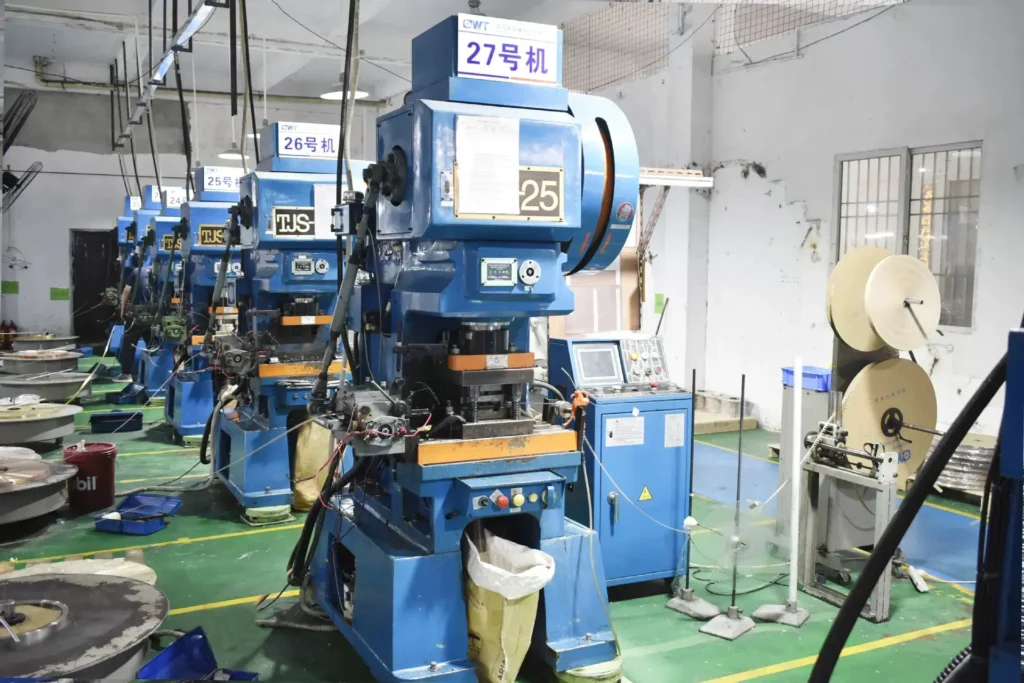
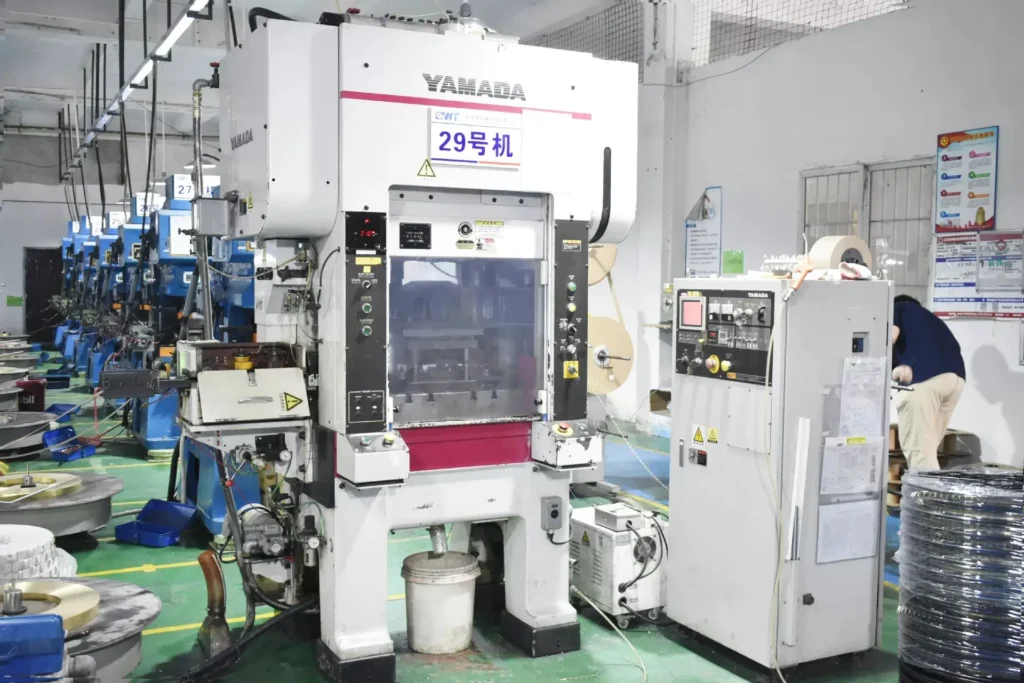
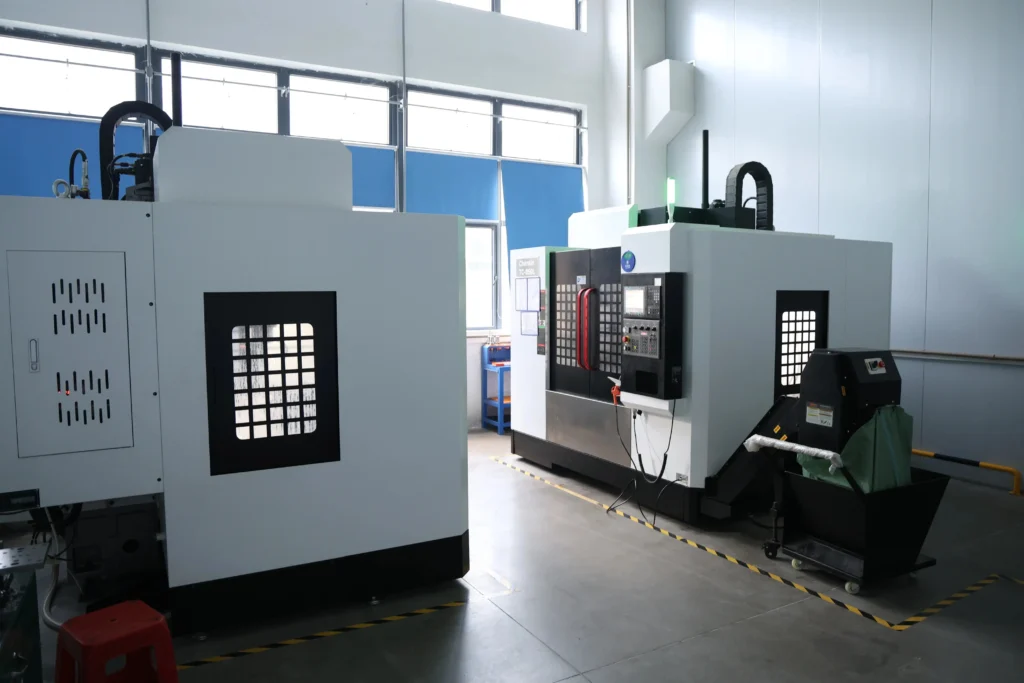
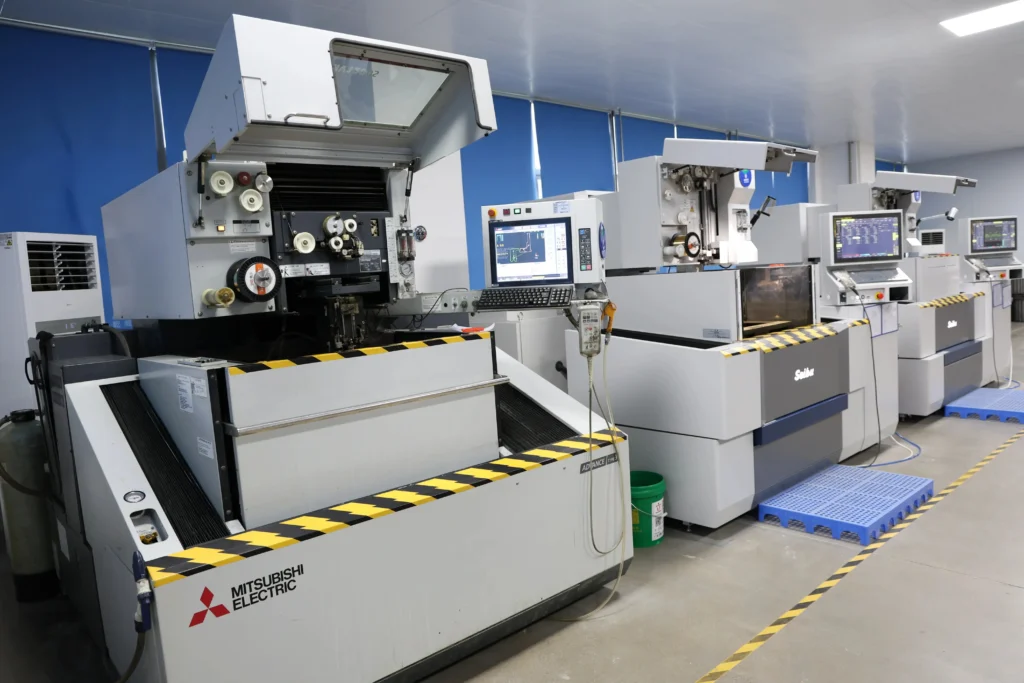
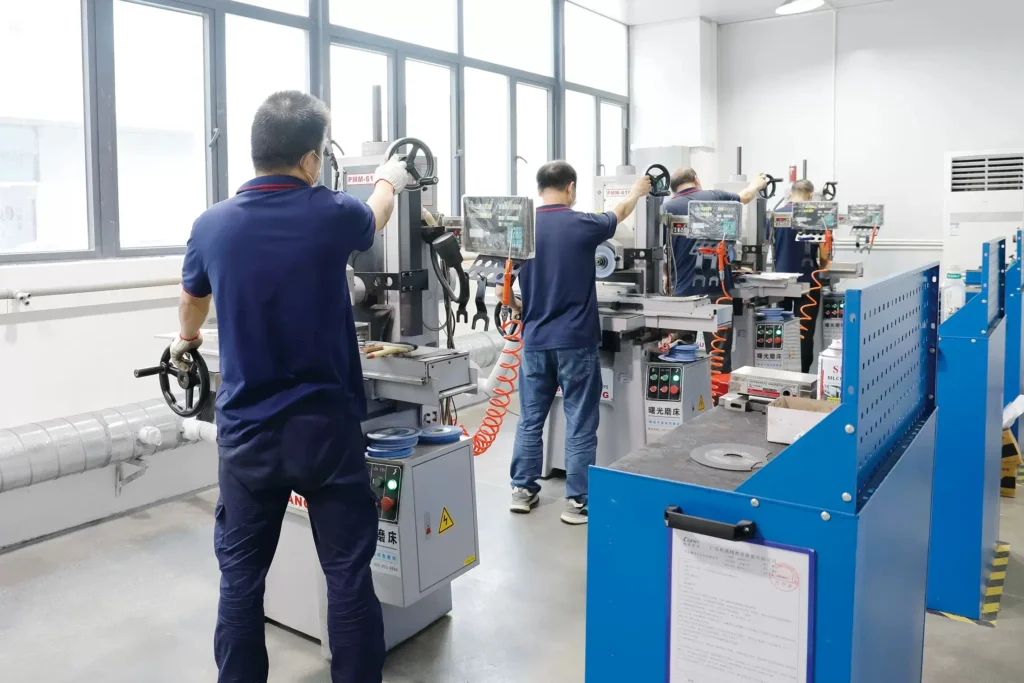
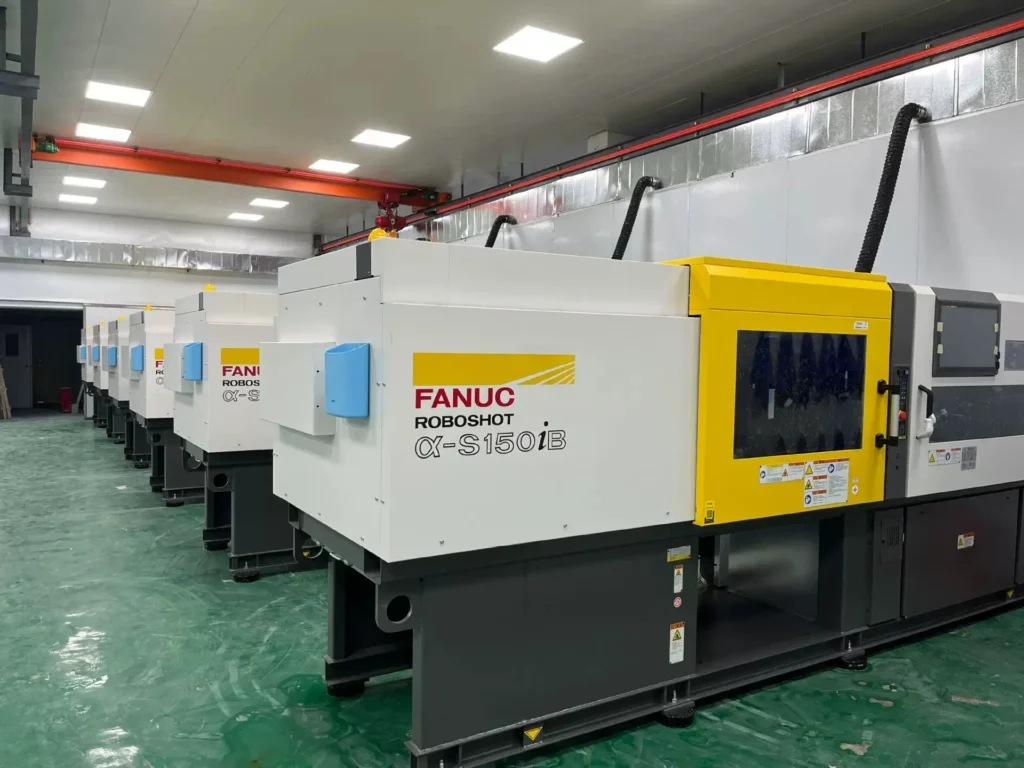
VoltixC is a factory with its own export team, not a trading company, and the workshop is in Baiyun District, Guangzhou. VoltixC was founded in 2021 and runs a 1,200 m² factory with 135 production machines. The team has 25 staff: 17 in production, 6 in export sales and 2 in R&D. The photos below were taken in the VoltixC workshop, and each caption names the process step the equipment belongs to.
VoltixC can show photos of the test equipment kept in its workshop; the photos prove the equipment exists, not that every batch is tested. Which inspection records ship with an order is agreed per order. Each caption names the test item the equipment is built for.
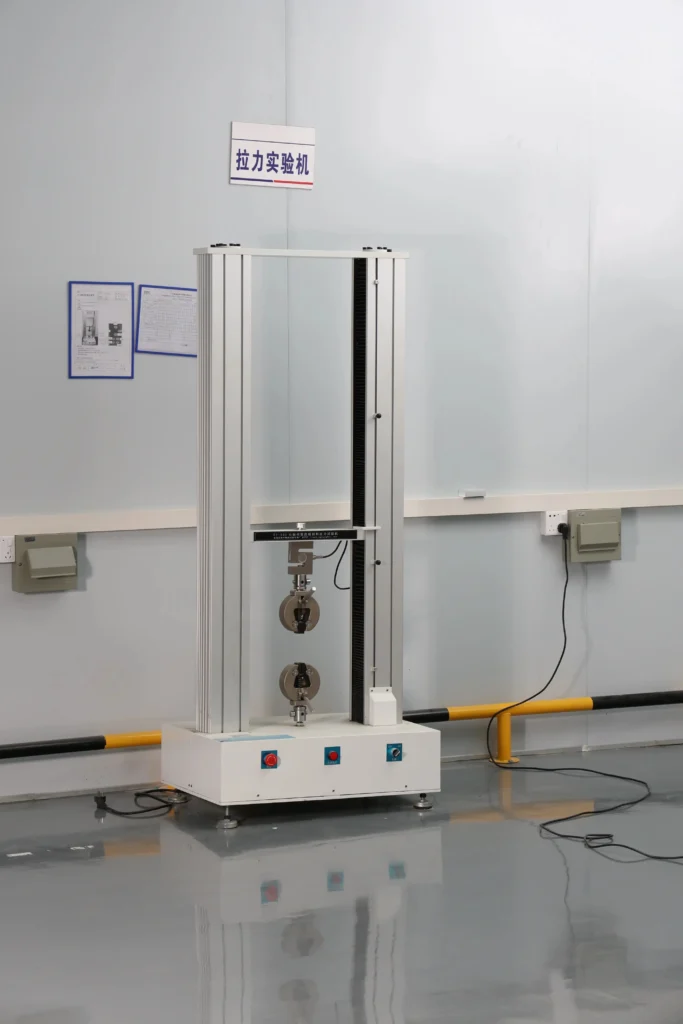
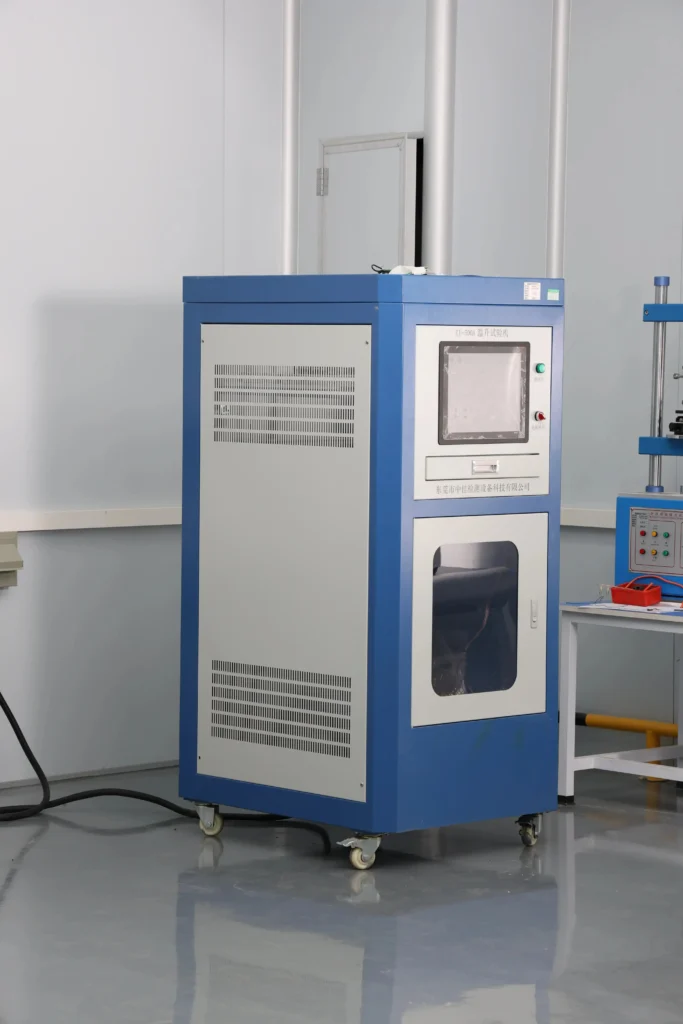
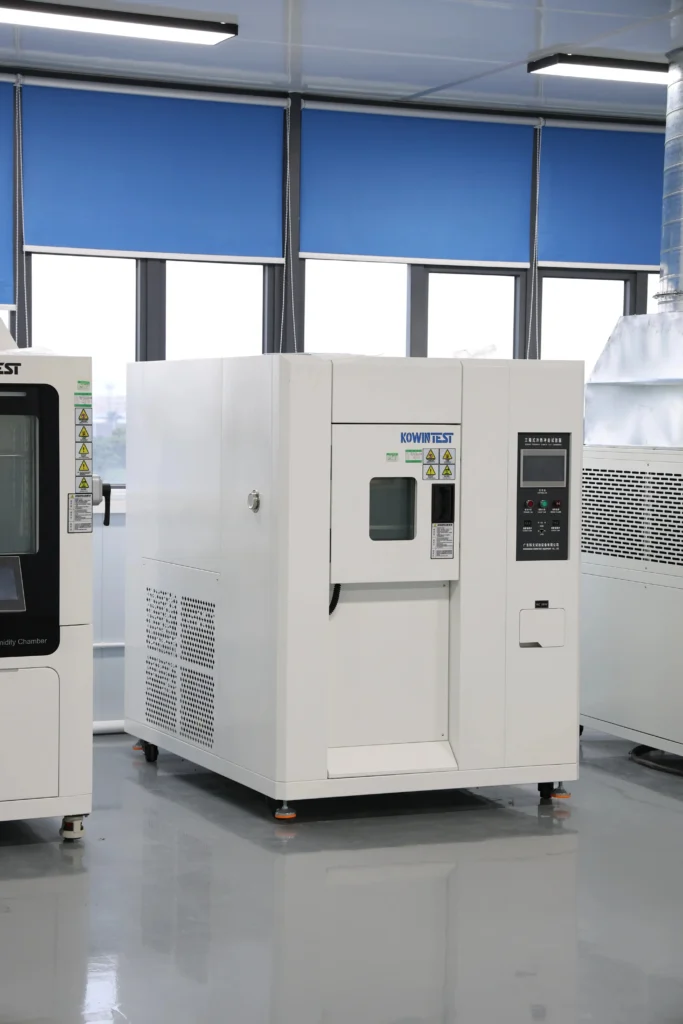
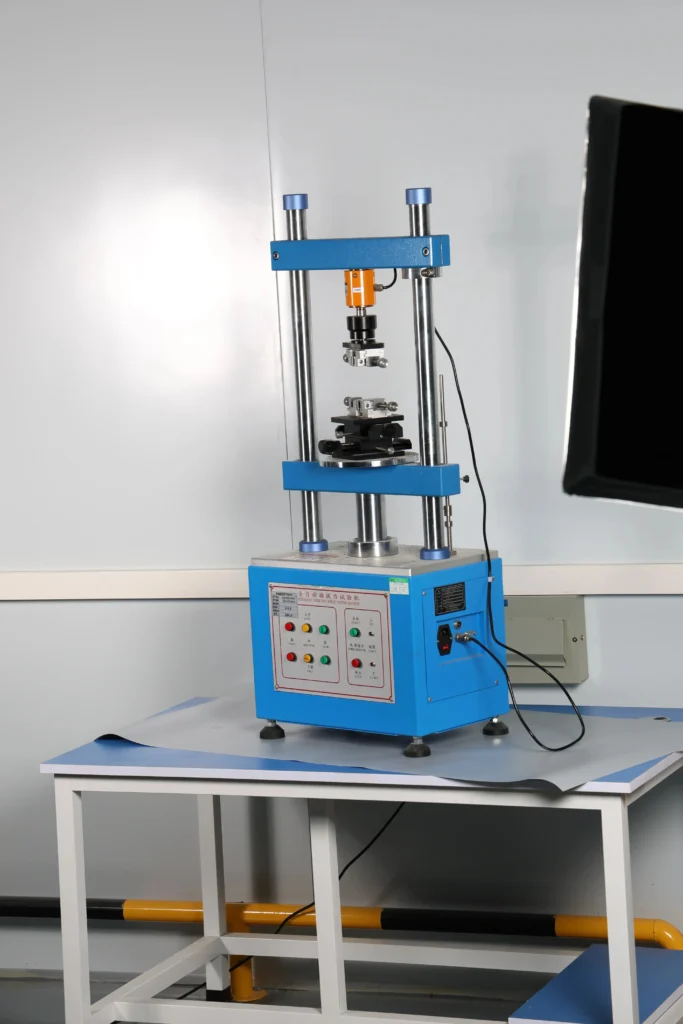
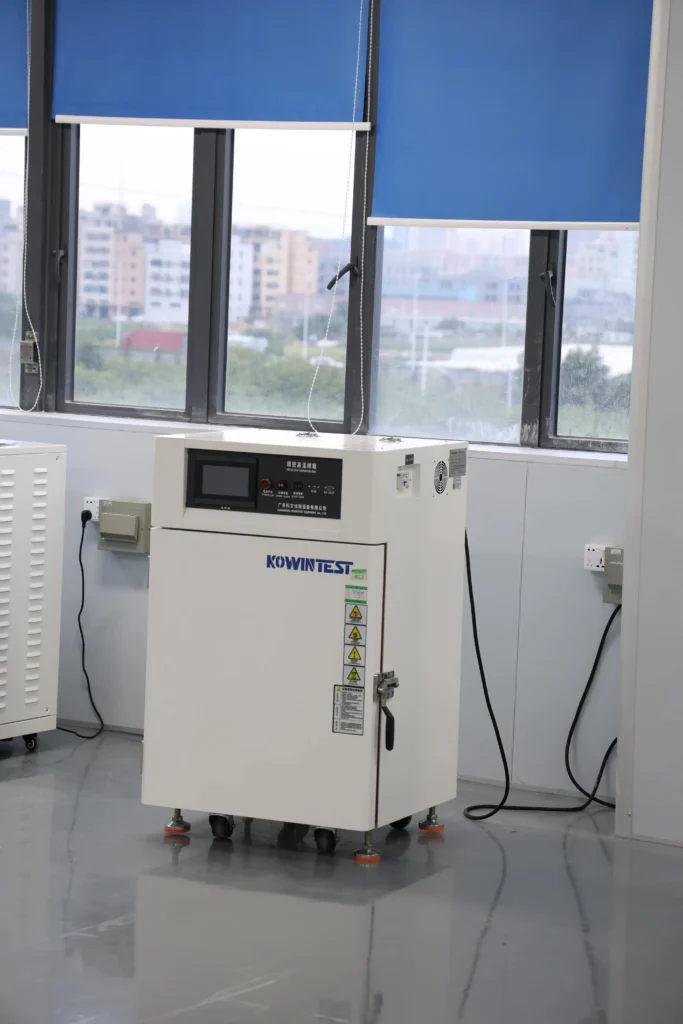
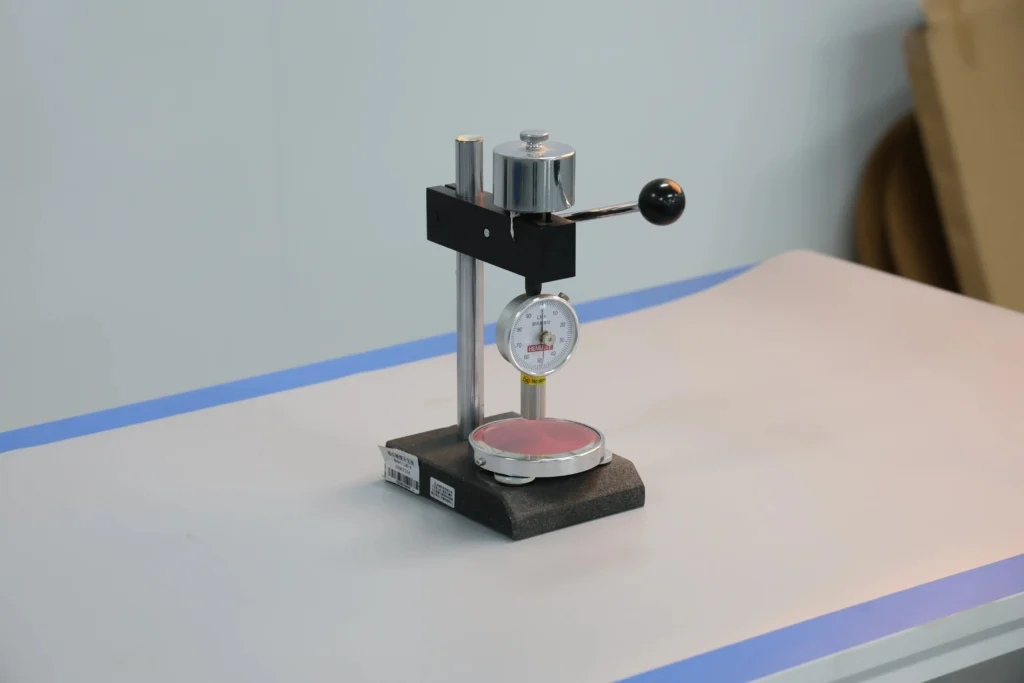
For a buyer, a tensile test shows how much pulling force a material or joint takes before it fails. A temperature-rise test shows how warm a connection runs while it carries current. A thermal shock chamber moves parts between hot and cold zones, and an insertion and extraction force test applies to quick disconnect and bullet terminals. The workshop also has an optical coordinate measuring machine for dimensional checks. Name the tests you need in your enquiry.
Yes, VoltixC is a lug manufacturer that can customize cable lugs and build new tooling when a standard lug does not fit, with tooling decided by order volume. The workshop’s tool-room equipment includes CNC milling, wire-cut EDM and grinding machines. Fastest sampling from 7 days, confirmed per order. Tooling time, lead time, MOQ and samples are confirmed per order by email or the enquiry form.
For a custom quote, send:
Custom work can be a small change to a standard series, such as a different hole size, a longer barrel or a narrower palm. Start from the closest product page and mark only the change on your drawing; that keeps the tooling review short.
The price of a cable lug is set by the size, metal and finish of the part, the tooling it needs, and the quantity and packing of the order. VoltixC quotes each order from those inputs and does not publish a price list. Each row of the table names one driver, what it does to the cost and what you decide.
| Driver | Effect on cost | What you control |
|---|---|---|
| Conductor size | Sets barrel diameter, wall and metal weight | AWG, kcmil or mm², and the conductor class |
| Terminal material | Sets the copper, aluminum or insulated route | Conductor metal and required terminal metal |
| Plating | Adds or removes a plating step | Bare copper, tin plated or another finish |
| Hole pattern and palm | May need a different die or punch | One or two holes, hole size, spacing and palm width |
| Insulation sleeve | Adds a molded or fitted sleeve | Vinyl or nylon, colour, partly or fully insulated |
| Tooling | New tooling only when no standard part fits | Accept a standard series or send a drawing |
| Quantity | Spreads setup across the batch | First order quantity and reorder rhythm |
| Packing and labels | Changes cartons, bags and label work | Bulk or bagged, label text and carton marks |
Source: VoltixC quote factors; no prices are published on this site.
You decide most of the cost in your first message. Pick a standard series from a product page and there’s no tooling. Put every size in one enquiry so the batch can be planned in one go, and give your reorder plan so the quote counts the full volume.
Two quotes from different cable lug suppliers for what looks like the same lug can come back at different prices. Barrel wall thickness, copper grade, plating thickness and how the palm is formed all move the cost. Lay both quotes against the same drawing and specification and go down them line by line; the part name alone won’t tell you much.
A quote you can compare against another cable lug supplier starts with five things in the enquiry. Send the drawing or product page link and the conductor size with its unit, then add the metal and plating, the quantity for each size, and the packing and label format. If cost matters more to you than a particular series, say so and the reply can set the closest standard series next to the custom option. On insulated terminals, the sleeve material and whether the barrel is fully insulated weigh as much as the metal. Bagged or labelled packing only moves the packing line of the quote.
Lead time, MOQ, samples and payment are confirmed per order by email or the enquiry form. Trade terms and the shipping port are settled the same way. Fastest sampling from 7 days, confirmed per order.
VoltixC is the brand of Guangzhou FuTeXin Technology Co., Ltd., founded in 2021, with its workshop at the registered address below. Check these details against your supplier onboarding records before the first order.
| Item | Detail |
|---|---|
| Brand | VoltixC |
| Legal name | Guangzhou FuTeXin Technology Co., Ltd. |
| Brand relationship | VoltixC is the brand of this company |
| Business type | Lugs manufacturer with its own workshop and export team, not a trading company |
| Founded | 2021 |
| Address | No. 50 Juyuan Street, Shijing Street, Baiyun District, Guangzhou, Guangdong, China |
| Contact | hugo@voltixconnect.com, 24/7 enquiry response |
Source: VoltixC company facts sheet, 2026.
VoltixC is a cable lug and wire terminal manufacturer in Guangzhou, China, with a 1,200 m² factory, 25 staff and 135 production machines, supplying copper tube lugs, mechanical lugs and insulated terminals to buyers in North America and Europe. Visits and video walk-throughs are not promised on this page; put any audit requirement in your enquiry.
Request a quote through the enquiry form or by email to hugo@voltixconnect.com; three details give the fastest quote: conductor size, stud hole and quantity. VoltixC answers enquiries 24/7. The checklist below lists everything that helps.
| What to prepare | Example or note |
|---|---|
| Conductor size and unit | AWG, kcmil or mm², plus the stranding class |
| Stud hole or hole spacing | Nominal stud, actual hole diameter or two-hole center distance |
| Material and plating | Copper or aluminum; bare or tin plated |
| Quantity | First order quantity and expected reorders |
| Drawing or sample photo | Mark key dimensions, orientation and where the lug is installed |
Source: VoltixC enquiry checklist.
The form asks for your product line, conductor size and quantity. Send drawings and sample photos by email to hugo@voltixconnect.com and quote your company name, so both reach the same enquiry. Several sizes can go in one enquiry. Terms for lugs and terminals are explained in the terminal glossary. Product parameters on this site come from supplier data and are not retested item by item.
Copper lugs are generally formed from copper tube or sheet: the barrel is shaped, the palm is flattened, the stud hole is punched and many lugs are then tin plated. Insulated terminals add a molded nylon or vinyl sleeve. The VoltixC workshop in Guangzhou has 135 production machines, including stamping presses and injection molding machines, and its tool and die parts are made on in-house CNC milling, wire-cut EDM and grinding machines. Photos of each machine type are shown in the workshop section above.
Cable lugs come in three main families: copper tube or compression lugs, mechanical set screw lugs and insulated crimp terminals. Within them, common shapes include one-hole and two-hole lugs, ring, spade, bullet and butt splice forms. Mechanical lugs suit terminations that may need to be re-made on site. VoltixC makes all three families, and the family selection table shows which one fits each connection.
Cable lugs are also called electrical lugs, wire lugs, crimp lugs, cable terminals, tube terminals and cable ends. Battery lugs and ring terminals are common names for specific shapes, and the mechanical form is called a set screw lug or screw lug. The VoltixC terminal glossary defines each term.
A lug connects a cable to a stud, bolt or busbar so current passes through a secure, reliable joint. The barrel grips the conductor and the palm bolts to the equipment. The connection method depends on the family: crimp, set screw or insulated crimp. A lug that is too large for the conductor will not grip it firmly, so size the lug to the conductor first.
Copper cable lugs fit a copper tube connection. A copper tube lug has a tubular copper barrel that is crimped onto stranded copper cable, and the VoltixC tube lug series are supplier-listed from 16 AWG to 1000/1250 kcmil. See the copper cable lugs page for tube, tinned and compression versions.
Match the conductor size first, then choose the palm whose stud hole fits your bolt. As a rule of thumb, 26–10 AWG goes to insulated terminals, 8 AWG to 4/0 AWG to copper battery lugs and 250 kcmil and up to the cable lug size chart. For two-hole palms, give the hole spacing as well as the hole size. If your stud size is not listed, send it with your enquiry and VoltixC will confirm a match.
Yes, VoltixC supplies mechanical screw lugs with aluminum bodies for copper or aluminum conductors, fitted with a hex key rather than a crimping die. The range also covers stacked mechanical lugs and lay-in grounding lugs with an aluminum-alloy body. Conductor ranges for mechanical lugs are confirmed per order; see the mechanical lug range for the product list.
Yes, VoltixC makes insulated wire terminals with vinyl and nylon sleeves. The range covers ring and spade terminals, quick disconnects, bullet connectors, butt splices, closed-end connectors, ferrules and solder-seal connectors, mostly listed in the 22–16, 16–14 and 12–10 AWG bands; nylon ring terminals are also listed at 8 and 6 AWG. See the crimp connector range for details.
In most cases, yes, when they go into equipment sold in the EU. The Commission states that all products with an electrical and electronic component, unless specifically excluded, have to comply with RoHS restrictions. RoHS Article 4 covers EEE placed on the market, including cables and spare parts for repair, reuse, updating or upgrading. RoHS maximum concentration values are measured by weight in homogeneous materials, so the copper, the tin plating and a vinyl sleeve are each assessed on their own.
Include the conductor size with its unit, the stud hole and the quantity. Add the material, plating and a drawing or sample photo if you have one. Samples, lead time and MOQ are confirmed per order, and the fastest sampling time is 7 days. The enquiry form and hugo@voltixconnect.com are both answered 24/7.
VoltixC answers enquiries 24/7. Send your conductor size, stud hole and quantity through the enquiry form or to hugo@voltixconnect.com, and the reply starts from your part, not from a price list.
Request a Quote